


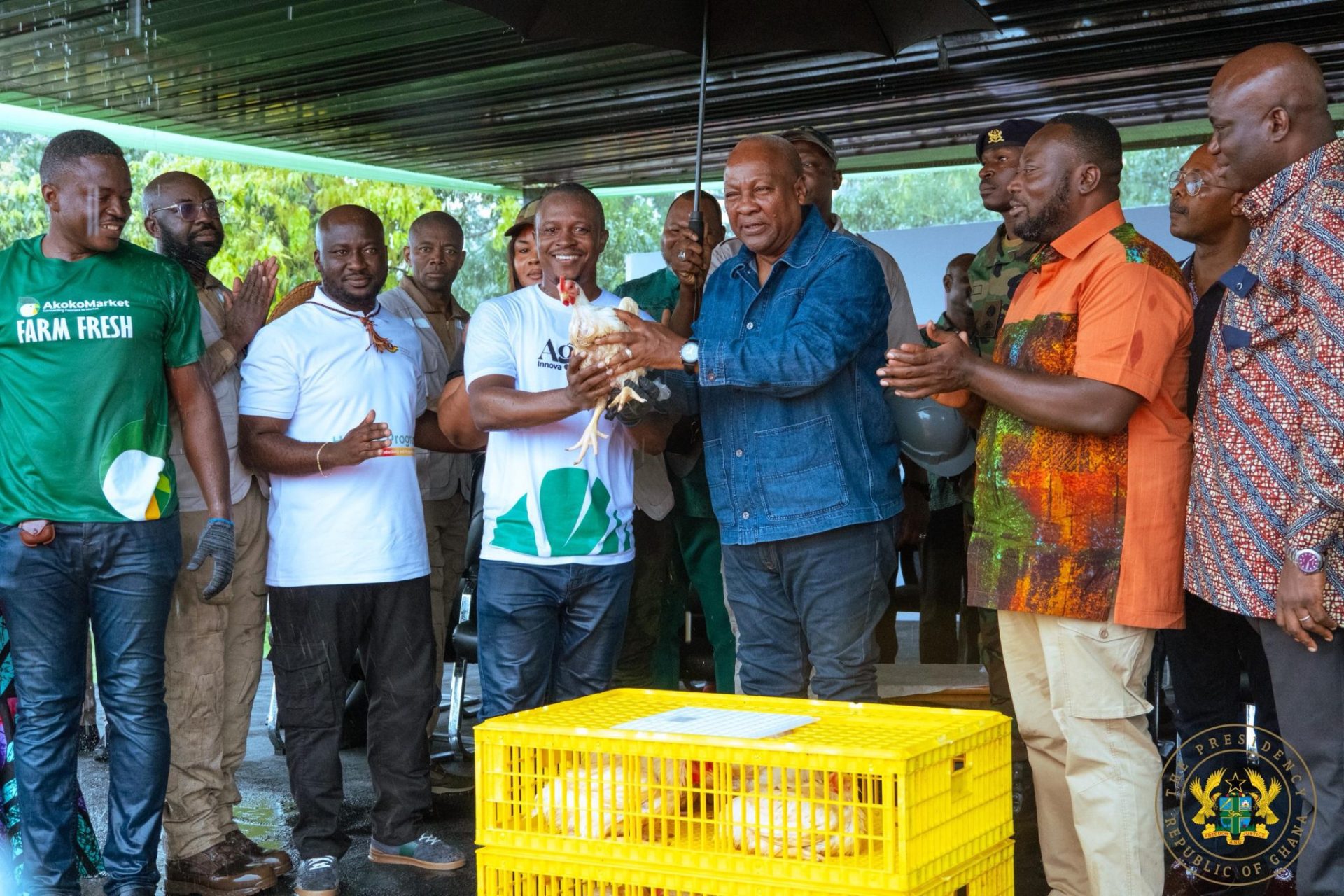
The Government of Ghana has unveiled bold plans to transform the National Service Authority’s (NSA) Papao Poultry Farm into a modern Centre of Excellence for poultry farming, training, and research. This initiative, led by President John Dramani Mahama, is expected to play a crucial role in strengthening food security, reducing reliance on poultry imports, and creating employment opportunities for young people.
Situated in the Domekwabenya Constituency of the Greater Accra Region, the Papao Poultry Farm has long been one of the NSA’s flagship agricultural projects. Currently, the farm holds about 70,000 birds, though it has the capacity to house 100,000. President Mahama, during a recent inspection visit despite heavy rainfall, expressed satisfaction with the progress made so far. He praised the Ministry of Youth Development and Empowerment alongside the staff of the National Service Authority for their dedication in revitalizing the farm. According to him, the facility will soon reach full operational capacity and become a significant contributor to Ghana’s poultry sector.
The government’s transformation plan for the farm is extensive. It involves upgrading the facility’s infrastructure and equipping it with modern processing plants that will allow the farm not only to produce live birds but also to process and package chicken for local markets. Plans are also in place for the construction of hostels to accommodate trainees, the procurement of vehicles to aid distribution across the country, and the establishment of a solar power system to guarantee consistent energy supply. These investments aim to make the farm self-sufficient, efficient, and capable of meeting both national and regional demand.
Beyond production, the Papao Poultry Farm is envisioned as a knowledge hub. It will provide training opportunities for graduates, farmers, and entrepreneurs who are eager to acquire practical skills in poultry management and agribusiness. The Centre of Excellence will also attract scholars, researchers, and development partners who can study best practices and introduce innovative methods that will further improve productivity. By integrating learning, production, and research, the government hopes to create a model that can be replicated in other regions of Ghana and even across West Africa.
President Mahama also used the occasion to launch the Nkokɔ Nkitinkiti Project, an ambitious national poultry initiative designed to strengthen local production. The project takes a three-tiered approach. Large-scale farmers will be supported with about four million day-old chicks, medium-scale farmers will receive three million, while households and young entrepreneurs will be provided with chicks, starter feed, and technical assistance. Importantly, all distributed chicks will be vaccinated to ensure healthy growth and minimize disease outbreaks.
One of the most innovative aspects of the project is its buy-back scheme. Farmers who rear the birds to maturity will have the opportunity to sell them back to government-approved processing plants. These plants will process, package, and market the poultry under the brand name “Nkokɔ Nkitinkiti,” ensuring that farmers have a guaranteed market while consumers benefit from safe, well-packaged, and locally sourced chicken. This arrangement not only encourages farmers but also strengthens the poultry value chain—from production and logistics to processing and retail.
The broader vision is to reduce Ghana’s dependency on imported poultry, a long-standing challenge for the local agricultural sector. Currently, Ghana imports a significant portion of the chicken consumed domestically. However, President Mahama has assured citizens that within three years, the country will produce almost all of its poultry needs locally. This will save foreign exchange, empower local farmers, and enhance the nation’s food security.
Acting Director-General of the National Service Authority, Madam Ruth Dela Seddoh, emphasized the importance of this initiative for Ghana’s youth. She noted that the farm will open up opportunities not only in agriculture but also in information technology, agribusiness, and other related sectors. According to her, the ultimate goal is to ensure that young graduates leaving national service are not left jobless but instead equipped with the skills and opportunities to build sustainable livelihoods.
The transformation of the Papao Poultry Farm represents more than just an agricultural project. It is a comprehensive national strategy aimed at job creation, youth empowerment, and economic self-reliance. By turning the facility into a Centre of Excellence, the government is laying the foundation for a poultry industry that is innovative, competitive, and capable of feeding the nation.
If fully realized, this initiative will not only make Ghana self-sufficient in poultry production but will also inspire a new generation of farmers and agripreneurs who see agriculture as a pathway to prosperity.
